Myanmar’s opposition NLD party, led by Aung San Suu Kyi, says it is on track to win more than 70% of seats in the country’s historic election – a tally that could sweep it to power and end decades of military dominance.
The National League for Democracy’s hopes of a decisive victory increased as Myanmar’s election commission began to release results from across the country.
The NLD won all 32 out of the first 32 seats announced for Myanmar’s lower house, plus three out of four seats for the regional assemblies, prompting celebratory scenes among supporters outside party headquarters in Yangon.
The party said ahead of an official announcement that it had won virtually every seat in four out of 14 states, including the region around the capital, where results were known.
— Kevin Doyle (@doyle_kevin)November 9, 2015
A total of 498 seats are being contested in the upper and lower houses of Myanmar’s parliament.
Aung San Suu Kyi earlier hinted at victory in Myanmar’s first free elections for decades, despite an unexpected delay in the release of the results.
In her first comments since the elections, she told a crowd gathered in Yangon, formerly known as Rangoon under the British empire, that the results would not be announced as soon as had been expected, “but I think you all have the idea of the results”.
“It is still a bit early to congratulate our candidates who will be the winners,” she said. “I want to remind you all that even candidates who didn’t win have to accept the winners, but it is important not to provoke the candidates who didn’t win to make them feel bad.”.
As many polling stations counted into the early hours of Monday morning, there were signs the NLD was set for a convincing victory. Htay Oo, the acting chairman of the ruling Union Solidarity and Development party, conceded that his party had lost more seats than it gained. “We have a higher percentage of losses than wins,” he said. “The results are not yet official but we accept any outcome,” he added.
House speaker and former ruling party chair Shwe Mann conceded defeat in the central Bago region. Other districts showed NLD gains although it was hard to tell if they represented the rest of the country.
The official Global New Light of Myanmar newspaper ran its Monday headline as “Dawn of a New Era” and said turnout was estimated at 70%, with 30 million eligible voters.
After nightfall on Monday, many NLD supporters have made their way to the
party’s Yangon headquarters, where huge screens and speakers showed
the official and NLD-collected results.
Streets stalls sold red flags with golden peacocks - the NLD banner - and smaller stickers that people stuck to their faces. Children wearing red headbands were hoisted by their parents onto parked cars to get a better view over the crowds. People snacked on pineapple and melon chunks bought from stalls on wheels.
Kyaw Zaw Shwe, 48, said he left Myanmar for Singapore five years ago to find a better salary as a chemical engineer but had come back to vote.
“There has been no change in the past five years,” he said, when asked about sweeping political reforms implemented by the quasi-civilian government that took over from the military junta.
“I voted in the 1990 election,” he said, referring to polls that were won by the NLD but later annulled by the generals. “In 1990, we kept we quiet. We celebrated but amongst ourselves,” he said, looking at the crowds, a rare sight in a country that suffered decades of oppressive rule.
The man was interrupted as another man, wearing an NLD flag as a cape, walked over to him. “Hello!” screamed the man, who identified himself as Myo Min Win.
“We were friends in Singapore because I worked there too,” Myo Min Win said. “We haven’t seen each other for years.”
They started discussing the election with vigor, both glowing red from the reflection of the giant LED screens. “I’m only 34, so I wasn’t old enough in 1990 to vote. This is the first time for me,” he told his friend.
party’s Yangon headquarters, where huge screens and speakers showed
the official and NLD-collected results.
Streets stalls sold red flags with golden peacocks - the NLD banner - and smaller stickers that people stuck to their faces. Children wearing red headbands were hoisted by their parents onto parked cars to get a better view over the crowds. People snacked on pineapple and melon chunks bought from stalls on wheels.
Kyaw Zaw Shwe, 48, said he left Myanmar for Singapore five years ago to find a better salary as a chemical engineer but had come back to vote.
“There has been no change in the past five years,” he said, when asked about sweeping political reforms implemented by the quasi-civilian government that took over from the military junta.
“I voted in the 1990 election,” he said, referring to polls that were won by the NLD but later annulled by the generals. “In 1990, we kept we quiet. We celebrated but amongst ourselves,” he said, looking at the crowds, a rare sight in a country that suffered decades of oppressive rule.
The man was interrupted as another man, wearing an NLD flag as a cape, walked over to him. “Hello!” screamed the man, who identified himself as Myo Min Win.
“We were friends in Singapore because I worked there too,” Myo Min Win said. “We haven’t seen each other for years.”
They started discussing the election with vigor, both glowing red from the reflection of the giant LED screens. “I’m only 34, so I wasn’t old enough in 1990 to vote. This is the first time for me,” he told his friend.
Aung San Suu Kyi, who has spent much of the past quarter-century under house arrest, is barred from the presidency by a junta-drafted constitution.
A key concern, that the army generals would annul the vote as they did when the Nobel peace prize laureate won a landslide in 1990, was rebuffed in the capital, Naypyidaw, where military commander-in-chief Min Aung Hlaing said there was “no reason not to accept the election results”, according to state media.
Labelled an “outpost of tyranny” by the US only 10 years ago, Myanmar has carried out reforms, releasing most political prisoners and allowing an independent press to operate. However, elections in 2010, in which current president Thein Sein came to power, were widely dismissed as a sham.
The 2015 polls were observed by around 10,000 election monitors, including many from the European Union and United Nations, and early indications from monitors suggested a largely transparent process.
Yet concerns over fairness were raised ahead of election day, with an estimated 4 million Burmese living abroad unable to vote and the exclusion of around amillion Rohingya Muslims, a stateless and persecuted minority.
The army has also enshrined its power in the constitution – reserving 25% of parliament seats – keeping the most powerful ministerial portfolios and banning Aung San Suu Kyi from the presidency as she has foreign family members. Her late husband was a British academic and she has two British sons.
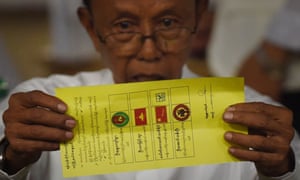
Jason Carter, grandson of former US president Jimmy Carter and an international election observer, said monitors would release a full evaluation, “including the political context in which this election is occurring”, on Tuesday.
Many in the country are worried about the post-election period, when Aung San Suu Kyi — who boldly announced last week she would be “above the president” — will negotiate power-sharing with the military.
Thai security forces along the Myanmar border, where multiple ethnic conflicts have raged, have been put on alert in preparation for violence following the election, the Bangkok Post reported in neighbouring Thailand.
Polls were cancelled in nearly 600 village areas, mostly in the conflict-affected states of Kachin and Shan, the election commission said, adding that a lack of security would not allow for transparent polling.
John Kerry, the US secretary of state, said in a statement that the election was an important step forward, but added it was “far from perfect”.
“A peaceful post-election period is crucial for stability and maintaining the confidence of the people in the credibility of the electoral process and the overall political transition,” he said.
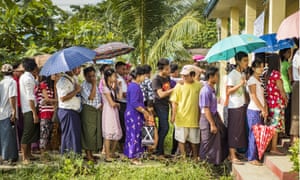
As the army is guaranteed blocs in parliament, the NLD must take 67% of all contested seats in order to gain a majority. If the party succeeds and forms a government, it will be the first democratically elected administration since the early 1960s.
Aung San Suu Kyi has promised to amend a constitution she has denounced as “very silly”.
The incumbent USDP would need far fewer seats as it is backed by the military. Ninety-one parties have contested the election in a country of about 51 million people.


